C-section
Feel tight, or pull when you stand tall, reach or bend?
Feel numb, or too sensitive for a waistband or bra strap?
Itch, burn or ache, even years later?
Look puckered, lumpy or stuck down?
Limit how a joint or your shoulder moves?
Make you avoid touching it, or even looking at it?
If any of these sound familiar, scar therapy may help.
Scar therapy is gentle, non-invasive treatment for scar tissue and the layers beneath it. I use specialist scar massage and fascial techniques, at a pace and pressure that suit you, then show you how to care for your scar at home.
When skin heals, the new tissue is thicker and less stretchy than before, and the layers underneath can stick together. That's often why a scar pulls, feels numb or aches. Treatment aims to help those layers move more freely, calm sensitive skin and make the scar softer and more comfortable.
Will my scar disappear? No. Nothing can make a scar vanish, and anyone who promises that isn't being straight with you. What many people notice is a scar that feels softer, moves better and bothers them less.
How scar therapy works →Recent or decades old. If yours isn't listed, just ask.
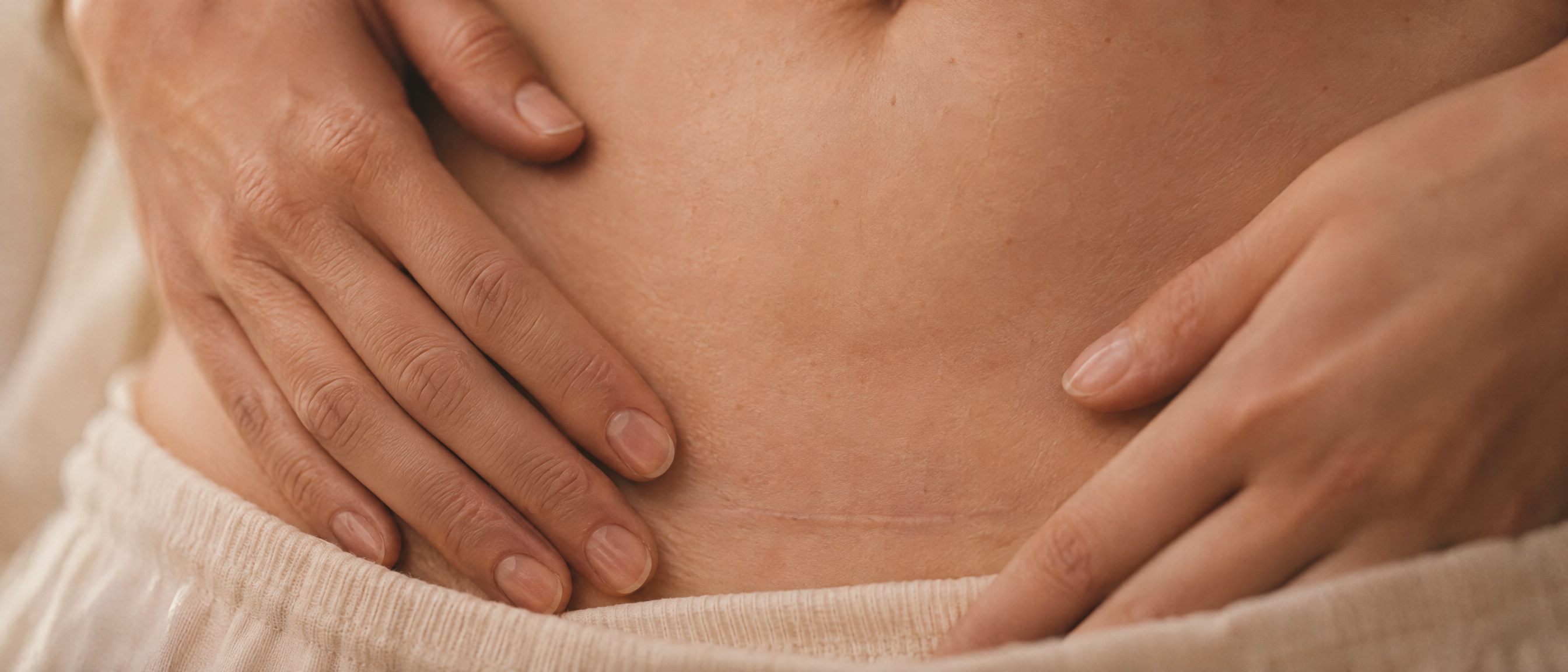
C-section scar massage for numbness, the "shelf", pulling when you lift your baby, or an ache years later.
Read more →

Mastectomy scar massage, lumpectomy, reconstruction and breast reduction scars, cording and a tight shoulder.

Knee, hip and shoulder scars that feel tight or sore when you bend and straighten.
Scar tissue after hysterectomy, gallbladder, hernia and keyhole surgery, plus tummy tuck scars.
Keloid and hypertrophic scar care alongside your doctor: silicone sheets and gel, pressure, and gentle work once your doctor is happy.
Healed burns, accident and sports-injury scars, including ones over joints.
Scars keep changing for up to two years, so starting early helps most: ideally in the first 6 to 12 months, once your wound has fully healed and your doctor or midwife is happy. But scars that are 5, 10 or 30 years old can still become softer and more comfortable.
01
Your surgery or injury, how the scar feels, and what you'd like to be different. I'll check how your scar and the tissue around it move.
02
Gentle scar massage and fascial release, with light suction (cupping) or supportive taping where they suit. You're in charge of the pressure, always.
03
Simple self-massage, moisturising and sun care, plus silicone if your scar is raised. Home care is half of the work.
Honestly: it's encouraging, and still growing. Here's where things stand.
A 2020 review of 19 controlled trials found that physical scar treatments improved pain, itch and flexibility compared with no treatment.
Deflorin et al., Journal of Alternative and Complementary Medicine, 2020
In a 2025 study of 30 women, one session of gentle suction made C-section scars measurably more elastic, with no side effects.
González-Muñoz & Navarro-Ledesma, Biomedicines, 2025
Most studies are small, so no one can promise a result. I'll always tell you what's realistic for your scar.
Lots of people avoid touching their scar, or even looking at it. Numbness can make part of your body feel like it isn't quite yours. And a scar can bring back the day it happened.
Sessions go at your pace. You can talk, or not. If feelings come up, that's normal and you're never rushed. If you're struggling with your mental health, I'll help you find the right support too.
Meet your therapist
I help people feel more at home in their bodies after surgery or injury, with calm, unhurried, hands-on care.
With a nursing background, I trained as an Amatsu Orthopath, holistic massage therapist and soft tissue therapist. I'm a qualified practitioner in two gentle, hands-on scar methods: RESTORE, used within the NHS, and MSTR® (McLoughlin Scar Tissue Release), practised in over 20 countries.
More about me →Scar therapy is gentle, hands-on scar treatment: specialist scar massage, fascial release, light suction and taping, plus a home plan. It aims to make a scar softer, more flexible and more comfortable, and to ease tightness, itch, numbness and pain.
Keloid treatment starts with your GP or a dermatologist, who may use steroid injections or other medical options. Alongside that, I can help with keloid and hypertrophic scar care: choosing and using silicone sheets or gel, pressure, and gentle work on the surrounding tissue once your doctor is happy. If a scar is getting taller or wider, act early.
No. No treatment, including laser or surgery, can remove a scar completely. Scar therapy aims to make it softer, flatter where possible, more comfortable and easier to live with, and often less noticeable.
Silicone sheets and gel have the strongest evidence of any home scar treatment: research shows they can make post-surgical and raised scars flatter, paler and softer, usually after several months of daily use. I'll show you which to use and how.
Yes. Starting in the first 6 to 12 months is ideal, but older scars from C-sections, joint replacements, hysterectomies and other surgery can still become softer and less tight.
At The Healing House, 32 Brunswick Street North, Stoneybatter, Dublin 7 (D07 TWX3). Clients come from Stoneybatter, Smithfield, Phibsborough, Cabra and across Dublin.
Book online, or send a message with any questions first. No pressure, no hard sell.